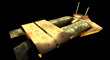
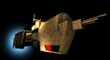
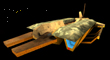
A civilisation that abandoned the concept of territory. The Feon-Tar do not colonise. They do not claim systems. They are their fleet, and their fleet keeps moving.
Playstyle
Mobile · Asymmetric
Difficulty
Advanced
Signature
No system claiming
Empire Ladder
Starwake → Nomadic Imperium
Who They Are
The Feon-Tar are native to the Milky Way's outer rim, and they have been here for longer than anyone else can prove. When the first Human cruiser group stumbled across them in 2284, mid-Ten-Year-War, their factory ships already looked older than humanity itself. The Confederate comms officer who logged the encounter described it as "a civilisation in slow exhalation". Their populations had stopped growing centuries before any Human had set foot off Earth. They are not the rising power they once were; they are the careful tenants of routes they have walked for so long that no living Feon-Tar can remember setting out on them.
They held the outer rim through the worst years of the Vatari War with nothing but repair ships and discipline. They lost their fleet capital in the first decade. They have spent the lifetime since rebuilding in tight spiral clusters: guarded, watchful, and very, very quiet.
"The system does not matter. The system is where we are now. Tomorrow is somewhere else."
Feon-Tar empires do not claim territory. They operate mobile factory ships that produce, mine, and repair on the move; their hyperspace drives are tuned for distance, not raw speed; and their Kasuda Dreadnaughts reach 50 light-years in a single jump. Their fleet is built around two extremes: enormous capital ships like the Kiban Command Cruiser and the Varmillion Super Star Cruiser, and a screen of fast, sturdy mid-line cruisers. Mid-tier filler is not their thing. They commit, or they leave.
Five Key Ships
Kiban Command Cruiser
Super Heavy Cruiser · Flagship
ATK 67DEF 50HP 18MP 5,000RP 242,200SLOTS 3
The largest capital ship a Feon-Tar admiral can field. 67 attack, 18 hit points, three equipment slots, and a build cost north of 240k. A single Kiban defines the centre of a Feon-Tar battle line.
Asona XB511 Fleet Command Vessel
Command Cruiser · Tactical bridge
ATK 44DEF 30HP 3MP 2,500RP 4,400SLOTS 2
The cheapest commandship hull in the galaxy at 4,400 RP, but with only 3 hit points, the Asona is a fragile bridge. Treat it as a spotter the player steps into through ARGUS, not a battle line ship. Lose it and switch to another Asona.
Kaysus Destroyer
Heavy Cruiser · Strike line
ATK 55DEF 40HP 8MP 2,500RP 52,900SLOTS 3
The Feon-Tar workhorse heavy. 55 attack tied with the highest in its class. Three equipment slots and a 50-LY jump range: your striking arm against slower neighbours.
Dullion Strike Carrier
Carrier · Mobile fighter hub
ATK 42DEF 30HP 3MP 2,200RP 5,500SLOTS 2
The Dullion's 60-LY jump range outreaches almost every rival carrier in the galaxy. A wing of Cyphers and Xylons launched from a Dullion can hit systems other races literally cannot reach.
Resource Collector
Mine · Mobile mining
RNG 100HP 8MP 0RP 1,050DEF 20
The Feon-Tar economy in one ship. The Collector is a mobile mining platform; it doesn't need a colony to function. Send it to a system, mine, leave. The 100-LY jump range means it can reach almost anything.
Empire Title Ladder
Feon-Tar empire titles are gated by MP usage instead of system count. The bigger your active fleet, the higher your tier; territory has nothing to do with it.
IStarwakeUp to 2,000 MP · Rank 10
IIVoid March2,000 - 6,000 MP · Rank 20
IIIHost6,000 - 12,000 MP · Rank 30
IVExodus12,000 - 20,000 MP · Rank 40
VNomadic Imperium20,000 - 30,000 MP · Rank 50
How They Play
Forget territory. You will never claim a system. Your dashboard's "Systems Owned" will read zero forever. Other races compete on territory; you compete on fleet weight. Stop thinking about borders.
Mine on the move. Resource Collectors with their 100-LY jump range can be redeployed weekly across half the galaxy. Run a small fleet of them around the perimeter, harvest, jump, repeat.
The Lubius and Bartornaw repair ships are your survival. With no home system to retreat to, you cannot afford to drag damaged ships back to a drydock; there is no drydock. Field repair units everywhere.
Past 30,000 MP-use you become Unstable. Feon-Tar crisis rolls aren't system uprisings; they're fleet-scale failures (logistics breakdowns, contagion sweeping through the fleet). Keep your MP-use under the threshold or have the support units to weather the storms.
You cannot designate a capital. The capital system is for races that have systems. The Feon-Tar's "permanent home" is wherever their command ships are this week.